
REPS Qualification Checklist for Real Estate Agents
Introduction
There are various tax benefits provided by the REPS classification to any individual involved in real estate ventures. First of all, an important benefit that comes from being classified as REPS is the classification of the rental real estate loss as non-passive loss, which enables one to apply these losses against income from another source, like wages, commissions, and business earnings. Nevertheless, to be classified as REPS, one should not only be engaged in rental activity but meet some criteria specified by the IRS in IRC Section 469.
Please use the below checklist to see whether you qualify for REPS or not.
What Is REPS?
Status of Real Estate Professional (REPS) is a tax classification which provides the ability to qualify individuals to classify their rental real estate activities as non-passive.

In general terms, rental losses are classified as passive losses, which means that they can only be deducted from passive income. Qualifying under REPS and materially participating in rental activities would enable an individual to deduct their rental losses from their ordinary income.
Advantages of REPS
- Ability to deduct rental losses against salary or business income.
- Decrease taxable income.
- Maximizes the tax saving potential for real estate professionals/investors.
- Enhances cash flow position by decreasing annual tax liability.
Are You Working on Real Estate for More Than 50% of Your Work Time?
One of the key conditions is known as the 50% Test. More than 50% of the personal services that you perform within a year must be done for the real property trades or business in which you materially participate.
Activities That Qualify as Real Property Business include:
- Real estate broker services
- Property management
- Real estate development
- Constructions and reconstructions
- Leasing and rentals
- Real property activities
Sometimes, it can be quite difficult for people to comply with the above requirement when they have another full-time job apart from their real estate business.
Questions to Ask Yourself:
- Am I working most of my time in real estate?
- Is there another occupation I am spending more time in than I am on real estate business?
- Can I prove how many hours I am working on real estate business?
Have You Worked Over 750 Hours in Real Estate?
In order to claim REPS, you need to have spent at least 750 hours a year doing real property trade or business in which you have materially participated.
Examples of Activities that May Qualify for 750 Hours:
- Showing houses or properties
- Working with tenants and clients
- Negotiating the agreements
- Managing the rented properties
- Advertising the listings
- Scheduling repairs and maintenance
- Administering real estate activities
Examples of Activities that Do Not Qualify:
- Studying reports of investments
- Watching the investments passively
- Researching about investing without any active participation
The IRS scrutinizes the REPS often; therefore, you should keep records of your hours.
Do You Have Material Participation in Your Real Estate Activities?
It is not sufficient to meet the hours only. It should also be shown that you have material participation where you are involved in the activity on a consistent, continuous, and substantial basis.
You Have Material Participation If:
- You do all the work yourself.
- You do more than 500 hours during the year.
- You are involved in more than 100 hours for the activity, and none is more involved than you in the same period.
- You are actively involved in the day-to-day activities.
Material Participation Examples:
- Communication with tenants.
- Rent collection.
- Scheduling repairs and maintenance.
- Budget review of the property.
- Property management.
Merely owning properties managed by someone else may not constitute material participation.
Are Your Activities Performed as Real Property Trades or Businesses?
Not all activities will meet the IRS criteria.
The Qualified Activities Are:
- Real estate brokerage
- Property management
- Construction and reconstruction
- Real property development
- Management of rental operations
- Management of leasing activities
- Acquisition of real property
Activities that Are Not Typically Considered Qualified:
- Passive real estate partnerships
- Real Estate Investment Trusts (REIT)
- Investment of capital without operating in the activities
It is necessary to verify whether your activities can be qualified as real property trades or businesses before applying for REPS.
Are You Documenting Your Activities Properly?
Documenting your work is probably one of the key requirements to qualify for REPS. Many taxpayers’ claims have been denied due to their inability to provide proof that they dedicated sufficient time to their activities.
Documentation Recommendations Include:
- Daily or weekly timesheets;
- Schedules and calendar;
- Email communication;
- Property management report;
- Meeting notes;
- Travel log;
- Financial statements;
- Repair and maintenance records.
Best Practices:
- Track your work regularly.
- Keep supporting documents on a regular basis throughout the year.
- Do not recreate your activities upon receipt of IRS letter.
Proper documentation may help you greatly defend yourself during the audit process.
Have You Grouped Your Rental Properties Together?
The taxpayer has an option to consider all his/her rental activities together to determine whether there was material participation.
Advantages of Grouping the Activities:
- Easier to qualify for the required participation time.
- Permits the taxpayer to combine his/her time spent on several properties.
- Easy bookkeeping.
- Gives a higher chance to become eligible for REPS.
The taxpayer should bear in mind that this choice will have consequences in the future, and it should be done after careful consultation.
Does Your Spouse Qualify?
There are certain aspects to take into account for those taxpayers who file jointly.
Important Aspects:
- BOTH spouses do not have to qualify separately for REPS.
- ONE of the spouses is able to qualify for REPS.
- Material participation of BOTH spouses can be taken into account.
Things to Avoid
Many individuals miss out on many tax breaks since they do not fully understand the REPS criteria.
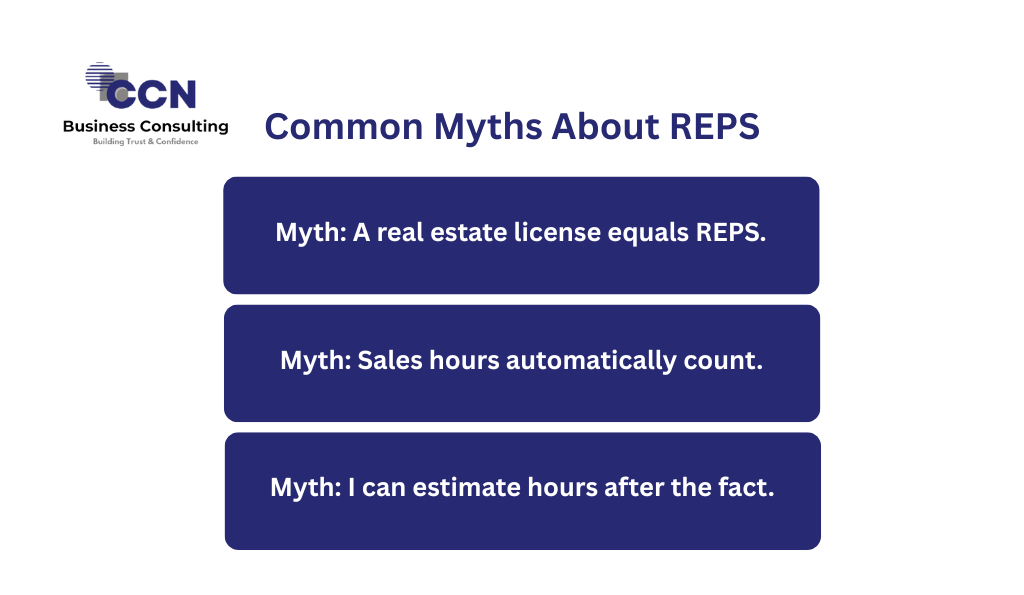
Typical Mistakes Made:
- Having the assumption that a real estate license will be enough.
- Trying but failing to satisfy the 50% rule due to having other jobs besides those in the real estate sector.
- Keeping inaccurate hours records.
- Misunderstanding the criteria of material participation.
- Passive owning rather than actively participating.
- Lack of proper documentation of rental activity.
Avoiding such errors can significantly increase your chances of qualifying for REPS.
Why It’s Wise to Seek Professional Advice
The REPS regulations are very technical and will need a lot of planning. Consulting a tax professional will ensure proper structuring of activities.
Tax Professionals Can:
- Ensure that your hours are recorded accurately.
- Help determine whether your activities are eligible.
- Group your rental activities properly.
- Ensure that all available deductions are maximized.
- Decrease audit risk.
- Avoid scrutiny by the IRS.
To know more about REPS and real estate taxation, visit https://ccnbusiness.com/.
Conclusion
Being able to claim the status of Real Estate Professionals offers many tax advantages for both real estate agents and real estate investors. Nonetheless, there is quite a bit of stringent criteria set by the IRS in order to become qualified. Therefore, by being aware of the requirements, keeping track of your time and consulting professionals, if needed, you will be able to qualify for REPS.