
| |

Does a Real Estate Agent Always Qualify for Real Estate Professional Status (REPS)?

Real estate agents hear about Real Estate Professional Status (REPS) at networking events, in forums, and in tax strategy guides — and with good reason. When claimed properly, REPS can allow taxpayers to treat rental real estate losses as non-passive, enabling those losses to offset other ordinary income. For some taxpayers this dramatically reduces tax liability.

But here’s the important caveat: holding a real estate license alone does not automatically qualify someone for REPS. Many licensed agents incorrectly assume they meet the IRS requirements. In reality, qualifying for REPS depends on the type of activities performed, how much time is spent on those activities, and whether the taxpayer materially participates in rental real estate.

This article explains what REPS is, when agents typically qualify (and when they don’t), why documentation matters, practical tips to improve your chances, and common pitfalls to avoid.

What Is REPS?

Real Estate Professional Status (REPS) is a tax classification under the Internal Revenue Code that allows qualifying taxpayers to treat rental real estate activity as non-passive if they materially participate. That distinction matters because passive activity loss rules typically limit the ability of rental losses to offset active income (like W-2 wages or business earnings). With REPS, those limitations can be removed — subject to other tax rules — giving significant tax planning flexibility for owners and investors who are substantially involved in real estate.

The Two IRS Tests for REPS

To qualify as a real estate professional for tax purposes, a taxpayer must meet both of the following tests in the same tax year:

  • 750-Hour Test: The taxpayer must spend more than 750 hours in real property trades or businesses during the tax year.
  • Materiality/Primary Activity Test: The taxpayer must spend more hours in real property trades or businesses than in all other trades or businesses combined.

Both tests must be satisfied annually — REPS is not a one-time certification.

When a Real Estate Agent Typically Qualifies for REPS

Some agents naturally meet the REPS criteria because of the nature of their work. Typical qualifying circumstances include:

  • 1099 / Self-Employed Agents: Agents who operate as independent contractors and control their schedules are more likely to log the required hours and demonstrate material participation.
  • Owner-Operators or Broker-Owners: Agents who own or manage a brokerage (or a significant ownership interest) and also materially participate in rental property management often qualify.
  • Active Property Managers / Investor-Agents: Agents who manage their own rental portfolio (handling tenant relations, maintenance, leasing, and bookkeeping) and can substantiate 750+ hours typically meet the tests.

Activities that generally count toward the hours test include: managing rental properties, coordinating and supervising repairs, screening tenants, negotiating leases, bookkeeping for rentals, and evaluating acquisitions. Sales activities can count toward the hours total — but only if they meet the material participation rules and, crucially, if those hours result in real property trade/service for which rental activities are connected.

When a Real Estate Agent Does Not Qualify for REPS

Just being active in real estate or holding a license does not guarantee REPS. Common situations where agents fail to qualify:

  • W-2 Agents Without Ownership: Agents employed as W-2 employees by a brokerage typically cannot count W-2 hours toward REPS unless they own at least 5% of the firm. Employment hours generally don’t meet the material participation test for REPS.
  • Part-Time Agents with Another Full-Time Job: Agents who sell or manage properties part-time while working full time elsewhere frequently cannot show that real estate activities exceed other business hours.
  • Agents Who Outsource Management: If an agent owns rentals but contracts out management (property manager, third-party management company), they may not materially participate in the rental activity.
  • Licensure Alone: Having a real estate license or earning commissions does not substitute for material involvement in the properties generating rental losses.

Documentation: What the IRS Expects

If you claim REPS, the IRS expects evidence — not estimations. A robust documentation practice is essential.

Recommended documentation includes:

  • Detailed time logs showing dates, hours, and a description of activities performed.
  • Calendars, appointment records, and email correspondence tied to property activities.
  • Invoices, work orders, and vendor communications that demonstrate managerial involvement.
  • Property records showing tenant interactions, lease negotiations, and maintenance oversight.
  • Business formation documents if operating through an entity (LLC, partnership).

During an audit, generalized or rounded hour estimates are more likely to be challenged. Accurate contemporaneous records substantially improve your credibility.

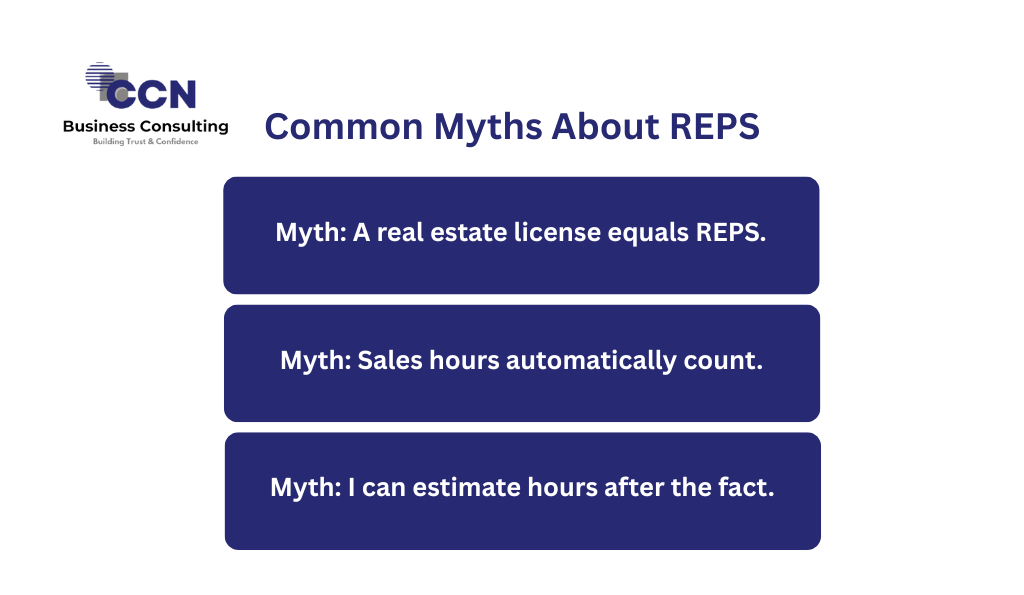
Common Myths About REPS

Here are a few persistent misunderstandings:

  • Myth: A real estate license equals REPS.
    Reality: License status is irrelevant to the REPS tests — hours and material participation matter.
  • Myth: Sales hours automatically count.
    Reality: Sales activity can count toward the hours test, but only if it is part of the real property trade or business and meets participation rules. Passive rental involvement remains separate unless material participation in rental operations is proven.
  • Myth: I can estimate hours after the fact.
    Reality: The IRS prefers contemporaneous records. Post-hoc estimates are vulnerable.

Practical Steps to Improve Your Chances of Qualifying

If your goal is to qualify for REPS, take these practical steps:

  1. Track Hours Daily: Use a time-tracking app or a dedicated calendar. Record task details and duration.
  2. Increase Active Involvement: Take on tenant communication, repairs coordination, lease negotiation, and bookkeeping tasks.
  3. Limit Outsourcing: The more you do yourself (within reason), the stronger your material participation position.
  4. Avoid Commingling Work Hours: If you have another job, clearly separate those hours in your records.
  5. Consider Entity Structure: Business structures (e.g., owning a brokerage or operating through a managed entity) can affect whether your work counts. Consult a tax advisor before changing the structure.
  6. Consult a Specialist: REPS is nuanced — a real estate-focused CPA can help document activity and advise on strategy.

For professional guidance, see our Tax Advisory & Planning Services.

Example Scenarios

Scenario A — Sarah (Likely Qualifies)
Sarah is a 1099 agent who markets properties full time, personally manages three rental units, handles tenant screening, coordinates repairs, and keeps detailed time logs totaling 1,200 hours for the year. She has no other employment. Likely qualifies for REPS.

Scenario B — Mike (Unlikely to Qualify)
Mike works 40 hours a week in a full-time corporate job and sells homes on weekends as a 1099 agent. He owns one rental property managed by a third-party manager. He doesn’t meet the 750-hour or material participation tests. Unlikely to qualify for REPS.

Scenario C — Jenny (Usually Disqualified)
Jenny is a W-2 employee of a large brokerage and earns a salary. She has no ownership stake in the brokerage and does not manage rentals. W-2 employment generally doesn’t count toward REPS unless she owns ≥5% of the firm. Unlikely to qualify for REPS.

Frequently Asked Questions

Q: Can sales commissions count toward the 750 hours?
A: Yes — sales activity may count toward the 750-hour threshold if it is performed in a real property trade or business and the taxpayer materially participates. However, commissions alone don’t satisfy the rental activity requirement unless tied to rental operations and material participation in that activity.

Q: Does my spouse’s activity count if we file jointly?
A: Yes. If one spouse qualifies as a real estate professional and the couple files jointly, the household can claim the benefits — but documentation must support the qualifying spouse’s hours and participation.

Q: If I own a brokerage, do my W-2 hours count?
A: If you own at least 5% of the brokerage, the IRS may allow you to count those hours. Ownership level and the nature of the work are critical. Consult a CPA before relying on this.

Q: How often must I re-qualify?
A: REPS must be satisfied every tax year you claim it. Keep contemporaneous records annually.

Q: What if I’m audited and I claimed REPS?
A: The burden is on you to substantiate the hours and participation. Good time logs, calendars, and third-party evidence (invoices, emails) substantially reduce audit risk. Engage a qualified tax professional immediately if audited.

The Bottom Line

Real Estate Professional Status offers powerful tax advantages, but it is not automatic. A real estate license or commission income alone won’t qualify you — you must satisfy both the 750-hour and material participation tests annually, and you must document your activity with care.

If you’re an agent who actively manages rentals and can substantiate time and tasks, REPS can be an effective strategy. If you’re part-time, primarily W-2 employed, or outsource most rental tasks, REPS is unlikely to apply.

Get Professional Help

Because the rules around REPS are technical and heavily fact-dependent, we recommend consulting a CPA experienced in real estate taxation before claiming this status on your return.

At CCN Business Consulting, our real estate tax specialists help agents and investors:

  • Evaluate whether REPS is appropriate for your situation
  • Build defensible documentation practices
  • Structure real estate operations for tax efficiency
  • Prepare for audits and maintain compliance

Ready to discuss your REPS eligibility?
Contact CCN Business Consulting to schedule a discovery call with our real estate tax team.

Similar Posts

Leave a Reply

Your email address will not be published. Required fields are marked *