

Tracking Real-Estate Investment Performance: Why the Right KPIs Make All the Difference
Investing in real estate offers significant opportunities — but it also demands clarity and discipline. At CCN Business Consulting, we see many investors make one consistent mistake: they own the asset but don’t actively monitor how it’s performing against clear benchmarks. When you skip that step, you risk not knowing when to hold, when to pivot, or when to exit.
That’s where Key Performance Indicators (KPIs) come into play. They’re not just nice‐to‐haves; they are your performance dashboard. If you’re serious about growing your real-estate holdings and making them work for you, tracking the right KPIs will give you the insight you need.
What Are KPIs in Real Estate and Why They Matter
A KPI (Key Performance Indicator) is a quantifiable metric aligned with your investment’s financial goals and operational strategy.
Core KPIs Every Real-Estate Investor Should Track
Here are the metrics we consistently recommend at CCN Business Consulting. These are powerful individual indicators — but far more effective when tracked together over time.
1. Cash Flow
Formula: Rental Income – Operating Expenses – Debt Service
This is your take-home from the property. Without positive cash flow, you’re relying on appreciation alone (which is riskier).
Recommended Benchmark: Aim for positive cash flow consistently.
2. Cash-on-Cash Return (CoC)
Formula: (Annual Pre-Tax Cash Flow ÷ Total Cash Invested) × 100%
This metric tells you how much return you’re getting on the actual cash you invested.
Recommended Benchmark: 8–10% CoC return is generally considered strong.
3. Net Operating Income (NOI)
Formula: Gross Operating Income – Operating Expenses
NOI gives you the core property income independent of financing and taxes.
Recommended Benchmark: NOI should be positive and growing year over year.
4. Capitalization Rate (Cap Rate)
Formula: (NOI ÷ Property Value) × 100%
Cap rate reflects market return expectations for similar properties.
Recommended Benchmark: Depending on the market, a 5–8% cap rate is typically healthy.
5. Internal Rate of Return (IRR)
IRR considers the timing of cash flows and the eventual sale, giving a long-term performance picture.
Recommended Benchmark: A solid investment generally yields 10–15% IRR over the holding period.
6. Occupancy Rate
Formula: (Occupied Units ÷ Total Units) × 100%
Vacancy impacts cash flow significantly.
Recommended Benchmark: Aim for 90–95%+ occupancy for stable performance.
7. Loan-to-Value Ratio (LTV)
Formula: (Loan Amount ÷ Property Value) × 100%
LTV indicates leverage and risk.
Recommended Benchmark: Keep LTV at 70–80% for balanced risk and financing efficiency.
How to Use These KPIs to Guide Your Strategy
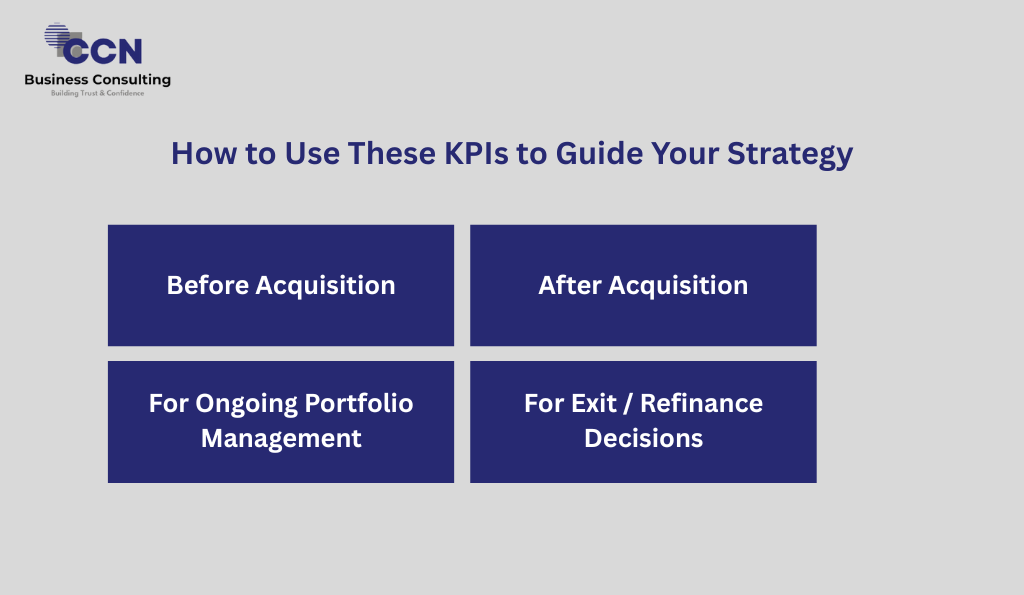
Knowing the numbers is only half the story. What really counts is how you use them.
Before Acquisition
During the underwriting phase, evaluate properties with CoC, Cap Rate, NOI and projected IRR. Make sure your target returns justify the risk.
After Acquisition
Track cash flow, occupancy rate, and NOI monthly or quarterly. When a KPI slips (for example, occupancy drops, or expenses surge), you have early warning.
For Ongoing Portfolio Management
Use trends, not just one-off numbers. If your CoC is declining or your equity is growing but ROE (return on equity) isn’t keeping up, you might need to reposition or exit.
For Exit / Refinance Decisions
When your IRR or equity multiple hits your targets ahead of schedule — or your cap rate environment changes — you may choose to sell, 1031 exchange, or refinance. KPIs give you the timing signal.
Common Mistakes Investors Make with KPI Tracking
Even experienced investors fall into traps. At CCN Business Consulting we see these repeatedly:
- Tracking the wrong KPIs: If you focus only on acquisition metrics and ignore operational KPIs, you’ll miss early signs of trouble.
- Tracking too many KPIs poorly: Having endless metrics with no process means none get monitored effectively. Better to track the right ones rigorously.
- Ignoring the context: A good Cap Rate in one market might be poor in another; KPI benchmarks vary.
- Failing to update or act: Metrics lose value if they’re recorded but not used to drive decisions.
- Poor bookkeeping or data integrity: If your underlying data is sloppy, your KPIs are misleading. As one expert warns: “If your income and expenses aren’t being tracked in detail, your performance metrics are nothing but guesses.”
How to Set Up a KPI System for Your Portfolio
Here’s a starter plan you can implement:
- Select your core KPIs from the list above — tailor to your strategy (buy-and-hold vs value-add vs flips).
- Ensure bookkeeping integrity — accurate income & expense tracking is foundational.
- Set benchmark targets — for example: minimum CoC of 10%, target occupancy of 95%, maximum LTV of 70%.
- Use dashboards or software for regular updates — monthly or quarterly. Automation reduces errors.
- Review and act — schedule a quarterly review: Are you hitting targets? If not, why not? What corrective actions?
- Communicate if you have partners or investors — transparency builds trust.
- Re-assess annually — markets change. What was a strong Cap Rate two years ago may need adjustment.
Final Thoughts
In real-estate investing, numbers tell the story — not intuition alone. If you want to move from owning properties to owning a portfolio that works, you should track the right KPIs, monitor them with discipline, and use the insights they provide to act proactively.
At CCN Business Consulting, we help investors set up their KPI frameworks, clean their bookkeeping, interpret the metrics, and drive strategy from the insights. If you haven’t yet built your performance dashboard, now is the time to get started — because what gets measured gets managed.