
Does Every Real Estate Investor Qualify for the Maximum Tax Benefits?
Real estate has long been celebrated as one of the most powerful wealth-building vehicles. From rental income and appreciation to long-term tax advantages, it offers opportunities many investors never fully utilize. At CCN Business Consulting, we work closely with real estate clients who want to optimize their tax position — but here’s a common misconception we must correct right away:
Not every real estate investor automatically qualifies for the most favorable tax benefits.
Tax advantages aren’t guaranteed simply because you own property. They’re tied to how involved you are, how your activities are structured, and whether your participation meets very specific standards.
This article breaks down what truly qualifies an investor to unlock powerful tax benefits — and why many investors mistakenly assume they qualify when they don’t.
Understanding Real Estate Tax Classifications
Before determining qualification, investors must understand how the IRS views their activities. Two key concepts matter most: passive activity rules and material participation.
Passive vs. Active Real Estate
Most rental activities are automatically considered passive unless proven otherwise. That means losses, even if significant, usually cannot offset your regular income.
But with the right level of involvement — and documentation — your real estate activity may shift out of this passive category.
Material Participation & Real Estate Activity
To access stronger tax advantages, an investor must demonstrate material participation. This means showing involvement in the operation of the real-estate activity on a regular, continuous, and substantial basis.
Without meeting this standard, the IRS considers your rental activity passive, and your tax benefits remain limited.
When Do Real Estate Investors Qualify for Stronger Tax Advantages?
Here are indicators that an investor is well-positioned to access more favorable tax treatment:
- They spend substantial time actively managing or making decisions for their rental properties.
- Real estate is their primary business or investment focus.
- Their involvement is documented clearly through logs, management tasks, decision-making notes, and records.
- They manage operations rather than fully outsourcing to management companies.
- Their accounting and record-keeping show consistent engagement with the property’s finances.
When structured correctly, this can open the door to broader loss deductions, depreciation benefits, and strategic tax planning.
Common Reasons Investors Don’t Qualify for the Maximum Tax Benefits
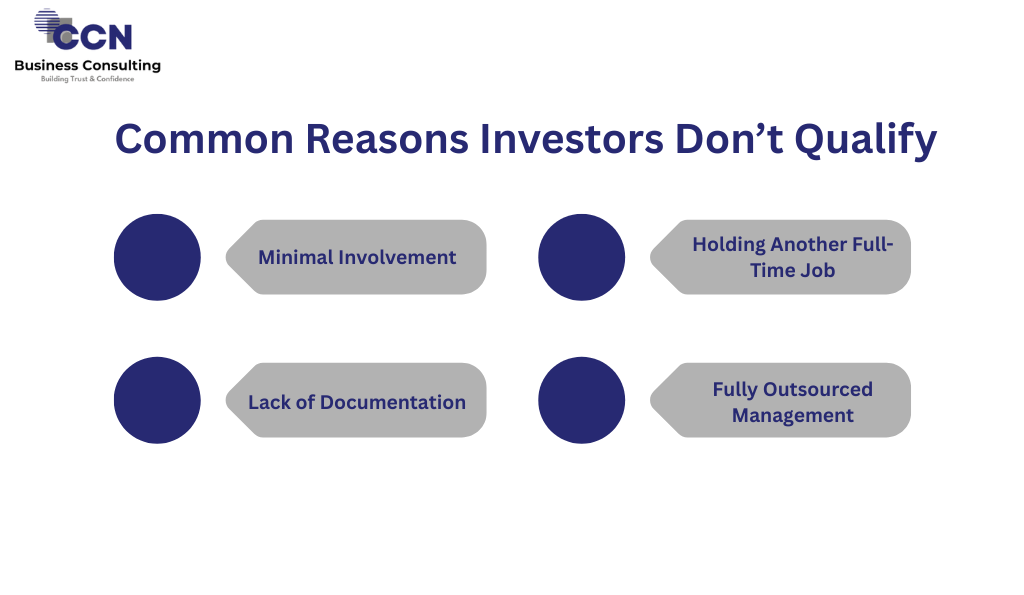
Many investors assume they qualify simply because they own property. But several pitfalls often keep them from unlocking maximum tax benefits:
Minimal Involvement
If your involvement is limited to the occasional repair approval or rent check, it’s unlikely the IRS will consider your activity anything other than passive.
Holding Another Full-Time Job
If real estate isn’t your main occupation, the IRS can view it as secondary — making qualification more difficult.
Lack of Documentation
Even if you do participate significantly, the absence of recorded evidence can weaken your claim.
Fully Outsourced Management
Investors who hand off everything to property managers often lose the ability to qualify for higher-level tax benefits.
Why Professional Guidance Matters
The IRS rules surrounding real-estate activity, material participation, and tax qualification are highly nuanced. For many investors, simply restructuring the way they operate or track their activities can dramatically change their tax outcome.
Working with a firm that specializes in real-estate taxation ensures:
- Your activities are structured to meet IRS requirements.
- You receive personalized guidance on maximizing deductions.
- Your financial systems, bookkeeping, and tax filings support your qualification rather than contradict it.
- You avoid costly mistakes or missed opportunities.
At CCN Business Consulting, we help investors build tax-efficient strategies, maintain accurate records, and position their real estate activities for long-term financial advantage.
Steps Real Estate Investors Should Take
If you want to strengthen your eligibility for expanded tax advantages, here’s what you can start doing today:
- Track your time — document hours spent on management, analysis, repairs, communications, and decision-making.
- Review your real-estate involvement — determine whether you truly operate your investments like a business.
- Evaluate your structure — assess whether your entity type and filings support your goals.
- Strengthen your accounting systems — proper books are essential for proving material participation.
- Get ahead of tax season — preparation and strategy matter more than filing forms at year-end.
Final Thoughts
Real estate tax advantages can be transformative — but they are not automatic. Investors who treat their activity as a real business, document their involvement, and meet IRS participation standards often unlock powerful tax benefits that others miss.
With the right structure and guidance, you can ensure your real-estate operations are aligned with the highest possible tax efficiency.